
MAKE DO AND LIVE
The Martian and Placemaking Beyond its Western Definition

Placemaking, alike vernacular, is a term that is fundamental to my research yet is quite possibly one of the hardest-to-define, yet most mundane, words I can think of.
The Oxford Dictionary defines it as “The action of ringing the changes on two bells in a way that makes room for a third” and regards it as an obsolete word since 1872, which is as frustrating as it is irrelevant. Yet the Cambridge Dictionary has no definition at all, so… point to Oxford, I suppose.
Wikipedia, however, has proven to outshine both with an explanation that at least resembles the definition I have been working with:
Placemaking is a multidisciplinary approach to planning, designing, and managing public spaces that highlights community involvement, human-centred design, and the development of meaningful, functional, and attractive environments.
While placemaking covers a variety of methods and scales, it is distinguished by improving urban vitality and reinforcing place identity by prioritising people over physical structures.
So what does this all have to do with The Martian, a science fiction movie about a man stranded alone on a planet with no public spaces, no community, and certainly no urban vitality to reinforce identity?
Well, that is where my research comes into play.
Much of urban theory (placemaking included) was developed with a very particular type of place in mind: Western cities in the Global North. Streets, squares, parks, neighbourhoods, infrastructure, density. But increasingly, we are forced to ask how these theories translate to contexts far beyond those conditions. What does placemaking mean where there are no permanent buildings? Where the “city” is a temporary camp? Where the community itself is displaced?
If we want to understand placemaking more broadly, we need to think about it in contexts where people are marginalised, displaced, or forced into environments never designed to become places at all.
If we start with the idea that placemaking is about “reinforcing place identity through prioritising people”, then it becomes quite obvious quite quickly that Mark Watney, the self-proclaimed “space pirate” stranded on Mars, spends most of the film doing exactly that.
Mars may be an empty planet, but Watney does not survive by simply existing in space.
He survives by making a place.
PART ONE: WHAT IS GIVEN AND WHAT IS TAKEN AWAY
At the start of the film, we see what is given.
The habitat, the equipment, the vehicles; everything is designed for the mission. Every object has a purpose tied to scientific experiment, exploration, and data collection. The environment is controlled, planned, and functional. It is an engineered space.
But crucially, it is not a place. It is infrastructure. It exists to support a project, not to support a life.
This distinction is important because many institutional environments on Earth operate in much the same way. Refugee camps, disaster relief zones, military installations, and research stations are designed as logistical systems. They prioritise efficiency, safety, and manageability above all else.
Shelter is provided. Water is provided. Food is provided.
But the spaces themselves are rarely designed with the expectation that people will actually live there.
They are designed to function.
In humanitarian planning, this is often deliberate. Camps are laid out in grids for easier surveillance, easier distribution of aid, and easier management of large populations. The architecture is temporary by design. Permanence is avoided because the assumption (or perhaps the hope) is that residents will not remain long enough for permanence to matter.
In other words, they are spaces built around an institutional horizon rather than a human one.
Mars, at the start of the film, is exactly this kind of environment. The habitat is not a home but a temporary outpost. The rovers are not vehicles for daily life but tools for exploration. The mission is structured around scientific goals rather than human rhythms.
Then the storm hits.
In the chaos of the evacuation, Watney is struck by debris and presumed dead by the rest of the crew. The mission leaves Mars, and suddenly, the carefully designed infrastructure is stripped of its original meaning.
The mission is over.
The experiment is over.
What remains is survival.
And this is where placemaking begins.
Watney’s priorities shift almost immediately. The scientific objectives of the mission become irrelevant; the habitat is no longer a research station but a shelter. The rover is not an exploration vehicle but a lifeline. Every object around him is reinterpreted through a new lens: not what was this designed for? But how can this help me live?
The built environment has not changed, but its meaning has.
Space becomes place.
Placemaking, in this context, is not about beautifying a city square or designing an attractive street corner. It is about survival. It is about transforming a hostile, indifferent environment into something structured, navigable, and meaningful enough for a human life to continue within it.
PART TWO: PoTaYtO
Once the immediate shock of survival passes, Watney begins the slow process of transforming the Martian habitat from infrastructure into something closer to a home.
The most obvious example is the potatoes.
Quick side note. These potatoes may be what started this blog: the desire to link research and academia to pop culture, when at school we were asked (as an extracurricular, mind you) to look into the science behind these potatoes and other fruit and vegitables to come up with a presentation about which vegitables would still be edible and which would be poisonous if grown on mars. 10 years later, and here I am talking about those same potatoes.
It is safe to say they left an impression.
In the film, Watney realises he can grow food using the crew’s remaining potatoes, Martian soil, and, rather less glamourously, his own “fertiliser”. It is a moment played partly for humour, but it is also deeply symbolic.
Agriculture is perhaps the oldest act of placemaking humans have engaged in. To cultivate land is to claim it, to invest it with labour and expectation, to transform an alien environment into something productive and familiar. For thousands of years, the act of farming has been the foundation of settlement.
Farming is not just about food.
It is about time.
Planting potatoes means believing you will still be alive when they are harvested. It establishes what phenomenologists and philosophers like Husserl, Heidegger, and Merleau-Ponty term as temporal horizons, the ability to imagine yourself existing in the future.
So Watney is not simply growing food, He is establishing a relationship with the environment around him.
The habitat becomes more than shelter; it becomes a place where things grow. That growth represents hope, or at least an expectation of a future, but also control. In a situation defined almost entirely by uncertainty, the potato farm becomes something predictable.
It is an act of agency.
It is an act of agency witnessed across displacement contexts, from the establishment of shops and markets, as seen in Al Zaatari [1], to young adults selling their rations (the only thing they have) to buy a phone [2].
Placemaking, just like planting, is an investment in tomorrow.
It says: I expect to still be here.
This may sound pessimistic, but it is also profoundly human. in these environments of indefinite temporariness, where time becomes something to control and manage, it is an act of agency, a choice made by the individual not just for them.
PART THREE: PANIC AT THE DISCO
If potatoes establish the future, disco establishes identity.
Watney’s only entertainment on Mars is the music collection left behind by his crewmate Commander Lewis, which happens to consist almost entirely of disco.
For most of the film, Watney complains about it relentlessly. But he still listens to it. Again and again.
Music, humour, and storytelling might seem trivial in comparison to oxygen levels or food supplies, but they are essential elements of placemaking. Culture anchors identity within space. It reminds people of who they were before displacement and who they still are despite it.
But culture also does something else: it resists reduction.
In emergency environments, people are often reduced to statistics. Camp populations are counted, managed, and categorised through systems designed to measure need and distribute aid efficiently. While these systems are necessary, they can also flatten the complexity of human life.
Cultural practices disrupt this reduction.
In refugee camps, music, food, storytelling, and humour reintroduce individuality and social identity into environments that are otherwise organised around management. In camps such as Domiz in Iraq, researchers have documented residents decorating shelters, painting murals, opening barbershops, and organising football tournaments. None of these activities is essential for biological survival, but they are essential for maintaining dignity and social belonging [3].
Watney’s disco problem operates in much the same way.
Listening to music, complaining about it, joking about his situation, and recording video diaries all serve to maintain a sense of personhood. He refuses to become simply a stranded astronaut awaiting rescue. Instead, he narrates his experience, turning survival into a story.
These small cultural practices anchor identity within space.
Without them, Mars would remain purely hostile terrain.
With them, it becomes something closer to lived space.
CONCLUSION:
While we suspend disbelief to watch Matt Damon become the most resourceful space pirate imaginable, it is worth remembering that the environment he navigates is not as alien as it first appears.
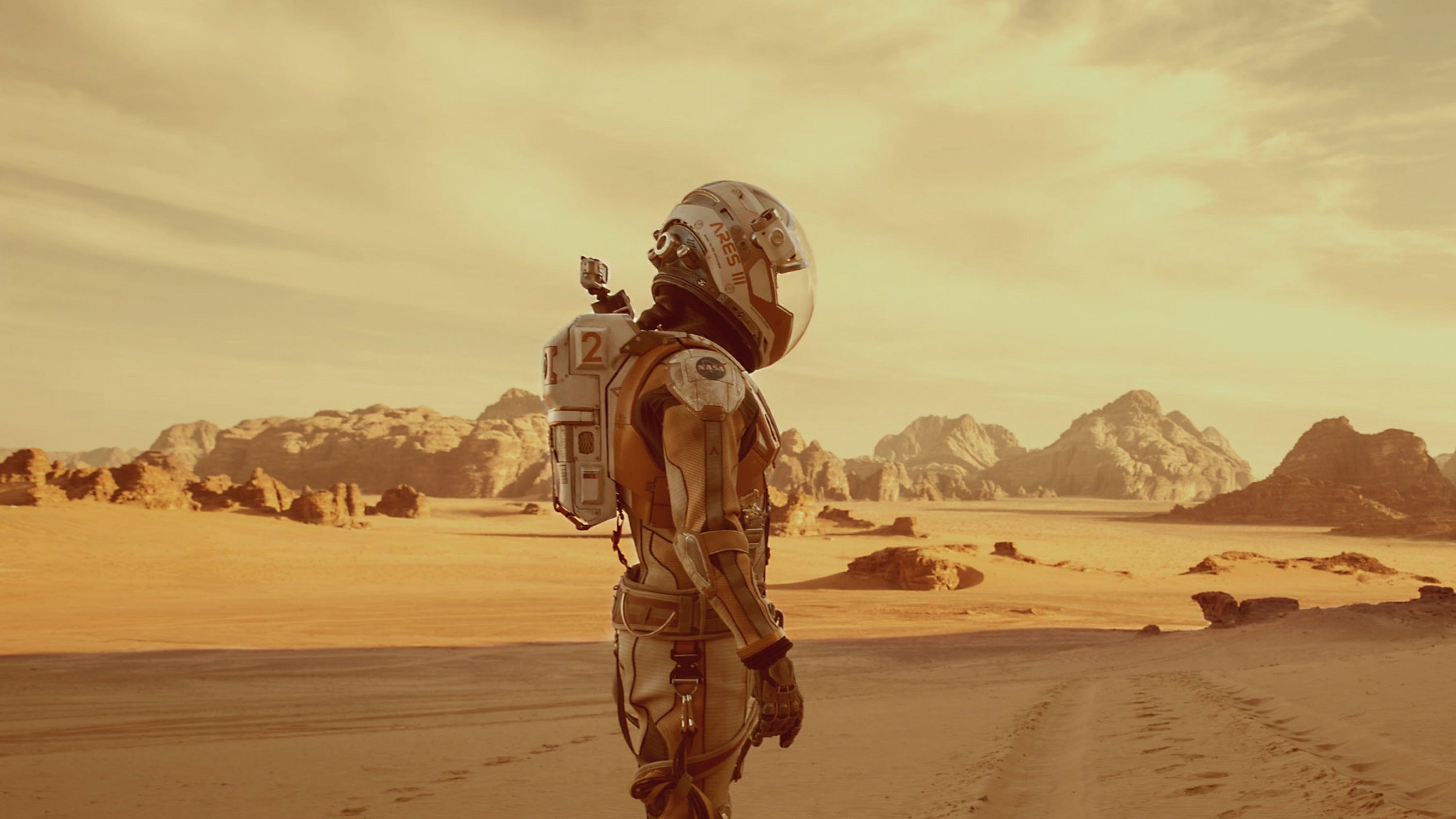
Much of the Mars landscape in The Martian was filmed in the deserts of Jordan, the same country that hosts two of the most studied refugee camps in the world: Zaatari Refugee Camp and Azraq Refugee Camp.
This does not mean the film is about refugees, of course.
But the visual parallel is difficult to ignore.
Mars in the film appears as an empty desert scattered with temporary infrastructure designed for a specific mission. Survival depends on improvisation, adaptation, and the ability to make meaning within an environment never intended to be lived in permanently.
In this sense, Watney’s story is not as alien as it first appears.
Across the world today, hundreds of millions of displaced people are living in environments originally designed as temporary emergency responses, with little infrastructure within a harsh and hostile environment. Camps built for short-term crises often remain in place for decades, a temporary permanent paradox. Entire generations grow up within them.
Like Watney, residents must learn to survive within systems not originally designed for ordinary life and like Watney, they make places anyway.
These acts of placemaking are not simply aesthetic choices. They are acts of agency. They are ways of reclaiming control, establishing identity, and projecting a future in circumstances defined by uncertainty.
Watney waits on Mars, knowing rescue may take years. Many refugees wait in camps without knowing if rescue will come at all. But in both cases, survival depends on the same thing.
Humans cannot live in space alone.
We have to make places first.
Thank you for reading! This blog is intended as a way to engage with the literature and themes I encounter in my research in a more accessible, reflective format. It allows me to process ideas and share insights without subjecting readers to the full scope of 1.5 years of research.
If this piece resonated with you, I encourage you to explore the literature that inspired it (some references are listed below). Please note that this blog offers only a surface-level introduction—there is only so much a couple of thousand words can capture. Think of it as a precursor to more in-depth journal articles to come.
Please, join the conversation. I would be fascinated to know how your research or experience resonates in pop culture!
[1] Al Waer, H. (2022). Al Zaatari Refugee Camp: the reassertion of a cultural identity. From Boundaries to Belvederes: framing the edge, 34-39.
[2] City of Thorns by Ben Rawlence (2016)
[3] Refugee Republic (2014) Jumpstarting a new existence in an emerging city. Everyday life in a refugee camp.
I love, love, love this so much. Bless your mind for creating this interesting piece. This is exactly the kind of content im looking for in substack! Looking forward to read more of your works 🙌🏽